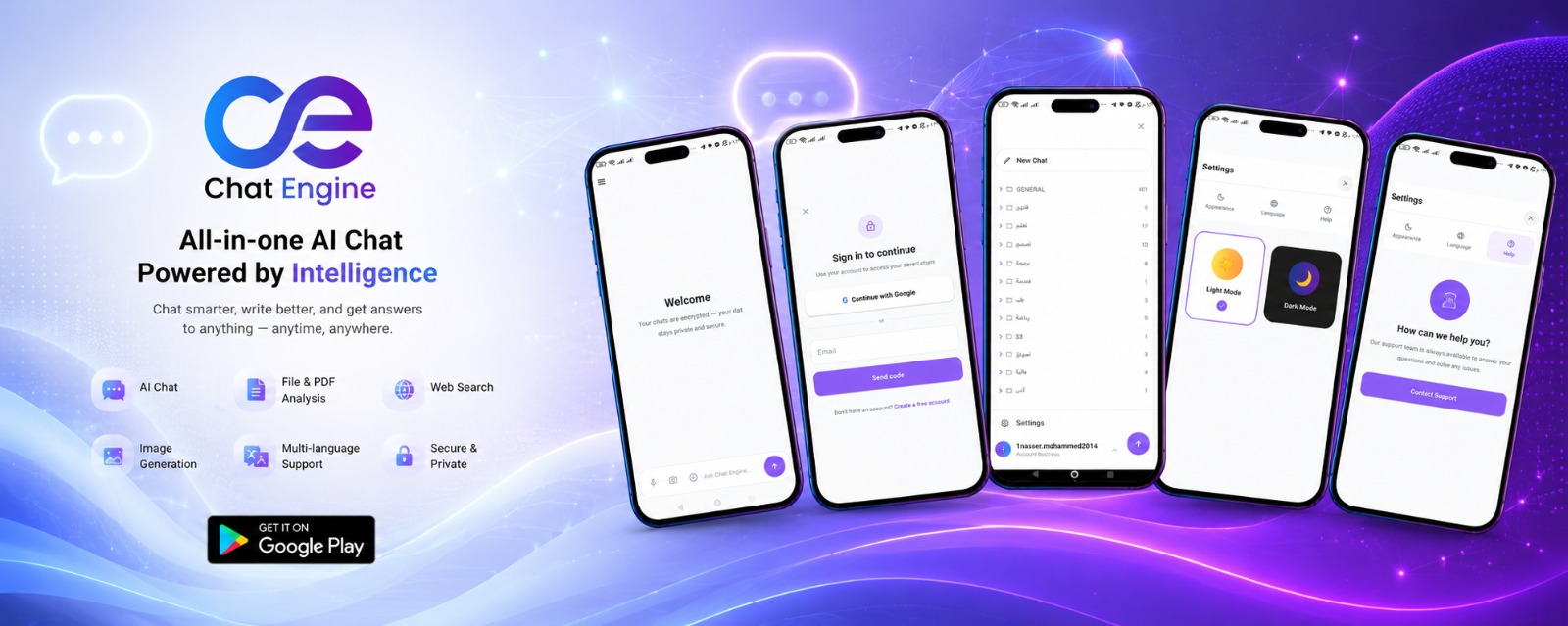
ChatEngine – Enterprise AI Platform for RAG, Knowledge Management and On-Premise AI
Enterprise AI is moving from experimentation to implementation. Organizations are no longer looking only for general-purpose AI assistants. They need AI systems that can securely work with their own documents, organizational knowledge, enterprise applications, and business processes.
ChatEngine, developed by Engine AI in Oman, is designed to support this transition.
ChatEngine combines Generative AI, Retrieval-Augmented Generation (RAG), enterprise knowledge management, organizational memory, application integration, and private or on-premise deployment into an enterprise AI environment.
The objective is to help organizations transform information into accessible, conversational intelligence.
What Is Enterprise AI?
Enterprise AI refers to the use of artificial intelligence within an organization’s business environment to improve knowledge access, decision support, productivity, customer service, automation, and business processes.
Unlike consumer AI applications, enterprise AI needs to address additional requirements, including:
- Data security and privacy
- Organizational knowledge
- Access control
- Enterprise application integration
- Data residency
- Governance
- Deployment flexibility
- Reliability and scalability
- AI response accuracy
An enterprise AI platform therefore needs to connect AI models with the organization’s existing information and systems.
This is where ChatEngine can become part of an organization’s digital infrastructure.
What Is RAG and Why Does It Matter for Enterprise AI?
Retrieval-Augmented Generation (RAG) is an approach that allows an AI system to retrieve relevant information from external knowledge sources before generating a response.
Instead of relying only on the information contained within an AI model, a RAG-based system can retrieve relevant organizational information and provide it as context to the model.
A simplified process looks like this:
User Question → Knowledge Retrieval → Relevant Context → AI Model → Grounded Response
For an organization, this can mean that employees can interact with AI using information from approved sources such as:
- Policies and procedures
- Technical manuals
- Contracts
- Project documents
- Reports
- Knowledge bases
- Training materials
- Product information
- Internal documentation
- Enterprise databases
RAG is more than connecting AI to PDFs
A production-ready enterprise RAG implementation requires much more than uploading documents.
Organizations need to consider:
- Document ingestion
- Data classification
- Metadata
- Document chunking
- Semantic search
- Retrieval quality
- Source attribution
- Permissions
- Data freshness
- Security
- Evaluation
- Monitoring
This makes RAG implementation an important part of enterprise AI architecture.
ChatEngine and Enterprise Knowledge Management
Organizations generate enormous amounts of information every day.
Knowledge can be distributed across documents, departments, applications, project files, emails, reports, databases, and individual employees.
The challenge is often not creating more information.
It is finding the right information at the right time.
ChatEngine provides a conversational interface through which users can interact with organizational knowledge.
Instead of searching through multiple folders or systems, employees can ask questions naturally.
For example:
“What is our procurement procedure for this type of purchase?”
Or:
“What documents are required before submitting this request?”
Or:
“What lessons were identified during the previous project?”
When connected to appropriate organizational knowledge sources, ChatEngine can retrieve relevant information and generate a conversational response.
Building Organizational Memory with AI
One of the emerging opportunities in enterprise AI is organizational memory.
Organizations accumulate knowledge through years of:
- Projects
- Decisions
- Policies
- Customer interactions
- Technical work
- Contracts
- Reports
- Lessons learned
- Operational experience
Much of this knowledge is difficult to access consistently.
Employees may know that the information exists but not where to find it.
Enterprise AI can provide an intelligent layer for accessing this accumulated knowledge.
From knowledge management to organizational memory
A useful model is:
Capture → Organize → Retrieve → Understand → Reuse
ChatEngine can support this model by providing a conversational interface over approved organizational knowledge.
This can help organizations make existing knowledge more accessible without requiring employees to learn complex search systems.
ChatEngine as an Enterprise Application
Enterprise AI becomes significantly more valuable when it moves beyond document-based question answering.
ChatEngine can also be integrated with enterprise applications through APIs and integration layers.
A typical architecture can look like:
User → ChatEngine → API / Integration Layer → Enterprise System → Data → AI Response
Potential integrations can include:
- ERP systems
- CRM platforms
- HR systems
- Customer service platforms
- Document management systems
- Internal portals
- Operational databases
- Business applications
This enables conversational experiences such as checking information, retrieving business data, or supporting specific workflows.
The exact capabilities depend on the systems, APIs, permissions, and use case involved.
On-Premise AI Deployment
For organizations operating in regulated, sensitive, or security-conscious environments, on-premise AI deployment can be an important requirement.
Some organizations prefer to maintain greater control over their:
- Data
- Infrastructure
- Network environment
- Security policies
- AI workloads
- Enterprise integrations
- Data residency
ChatEngine supports private and on-premise deployment models for organizations that require AI capabilities within their controlled infrastructure.
This can be particularly relevant for industries such as:
- Government
- Energy and Oil & Gas
- Healthcare
- Banking and Financial Services
- Telecommunications
- Defense
- Critical Infrastructure
On-premise AI can also allow organizations to design the deployment around their existing security and infrastructure requirements.
Enterprise AI Security and Access Control
Connecting AI to organizational information introduces an important requirement:
Not every user should have access to every piece of information.
Enterprise AI implementation therefore needs to consider authorization and access controls alongside AI capabilities.
A secure architecture should consider:
- User authentication
- Role-based access
- Data permissions
- Application permissions
- Knowledge-source permissions
- API authentication
- Data protection
- Auditability
- Deployment boundaries
ChatEngine can be integrated into enterprise environments where access to information needs to follow organizational controls.
The AI experience should not become a shortcut around existing security policies.
Enterprise AI Implementation: From PoC to Production
A successful enterprise AI project requires more than selecting an AI model.
Organizations need a structured implementation process.
1. Identify the Business Use Case
Start with a specific problem rather than attempting to deploy AI everywhere.
Potential use cases include:
- Enterprise knowledge assistant
- AI-powered enterprise search
- Policy assistant
- Technical support assistant
- Customer service chatbot
- Employee assistant
- Document intelligence
- Knowledge management
- Conversational access to enterprise applications
2. Identify Knowledge Sources
Determine where the required information currently resides.
This may include:
Documents + Databases + APIs + Enterprise Applications + Knowledge Bases
3. Design the RAG Architecture
Determine how information will be:
- Ingested
- Processed
- Indexed
- Retrieved
- Presented to the AI model
The architecture should also address document updates and information freshness.
4. Establish Security and Governance
Define who can access which information and how the AI system should interact with enterprise systems.
5. Build a Proof of Concept
A focused enterprise AI PoC allows an organization to test the technology against real business scenarios before expanding the deployment.
Evaluation can include:
- Answer accuracy
- Retrieval quality
- Response relevance
- Source grounding
- Security
- Response time
- User experience
- Operating cost
6. Move from PoC to Production
Once the use case has been validated, the implementation can expand to additional departments, knowledge sources, applications, and users.
Why Enterprise AI Implementation Matters
Powerful AI models are becoming increasingly accessible.
The competitive difference for organizations will increasingly come from how effectively AI is implemented within the organization.
This means connecting:
AI Models
- ●
Organizational Knowledge
- ●
RAG
- ●
Enterprise Applications
- ●
Security
- ●
Workflows
- ●
Deployment Infrastructure
Together, these components create an enterprise AI architecture rather than simply another chatbot.
ChatEngine Enterprise AI Capabilities
ChatEngine is designed to support organizations looking to build practical AI applications around their own information and systems.
Generative AI
Use conversational AI for content generation, analysis, question answering, and productivity.
Retrieval-Augmented Generation
Connect AI responses with approved organizational knowledge sources.
Enterprise Knowledge
Make organizational information easier to access through natural-language interaction.
Organizational Memory
Create a conversational layer for accessing accumulated organizational knowledge.
Enterprise Integration
Connect ChatEngine with business applications and enterprise systems through APIs.
Multi-Model AI
Support the use of different AI models according to organizational requirements and use cases.
Private and On-Premise Deployment
Deploy AI within private or controlled infrastructure where required.
Enterprise Security
Design AI implementations around organizational authentication, permissions, data access, and governance requirements.
From AI Chatbot to Enterprise Intelligence
The next stage of enterprise AI is not simply about having an AI chatbot.
It is about connecting AI to the organization’s knowledge, systems, people, and processes.
An AI assistant that can answer general questions is useful.
An enterprise AI platform that can understand organizational knowledge, retrieve relevant information, interact with enterprise applications, and operate within the organization’s security and deployment requirements can become part of the organization’s digital infrastructure.
That is the direction ChatEngine is designed to support.
The Future of Enterprise AI in Oman and the GCC
Organizations across Oman and the wider GCC are exploring how AI can be integrated into government, energy, healthcare, finance, telecommunications, logistics, manufacturing, and other sectors.
For these organizations, enterprise AI adoption requires more than access to a general-purpose AI model.
It requires local implementation capability, enterprise integration, knowledge management, security, and deployment flexibility.
ChatEngine is being developed in Oman with this enterprise environment in mind.
By combining generative AI with RAG, organizational knowledge, enterprise applications, and private deployment options, ChatEngine provides an architecture for organizations exploring the next generation of AI-powered productivity and knowledge management.
Build Your Enterprise AI Strategy with ChatEngine
The important question for organizations is no longer simply:
“Can AI answer questions?”
The bigger question is:
“How can AI understand our organization, work with our knowledge, connect to our systems, and help our people work more effectively?”
ChatEngine is designed to help answer that question.
From organizational knowledge to conversational intelligence.
From AI experimentation to enterprise implementation.
From information to productivity.
Explore ChatEngine
Explore Engine AI